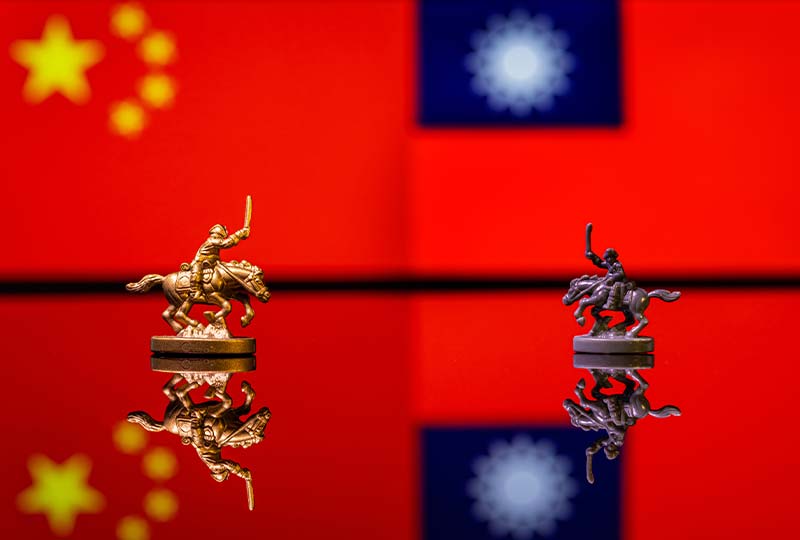
When it comes to the ongoing tension in the Far East, it is likely not a question of if but rather when the Chinese military confrontation with Taiwan will reach its peak.
If it does occur, it may not be limited to a regional conflict. Russia versus Ukraine had relatively minor international repercussions. Israel versus Iran and its proxies has had the potential for widespread energy and other disruptions, but so far those have generally not transpired.
But China’s move against Taiwan will certainly impact worldwide trade, at the least. The West is likely to boycott its huge China trade market. The United States and its allies will almost certainly provide Taiwan with military and political support, and could very well engage China in the air and at sea.
Why now? China has hoped for “unification” with Taiwan through diplomatic and military pressure. But if Taiwan continues to resist unification or declares impendence from China, the leadership on the mainland could order an invasion.
A blockade instead of invasion?
Another option is a blockade of the island nation. China has recently held its largest military exercises around Taiwan. The drills were designed to show Taiwan and its allies that it could cut off food, fuel, and other necessities by sea. And, it could also control the skies, so that any aid from there would be blocked. Taiwan’s President Lai Ching-te has ruffled the Chinese with his pro-separatist talk, and neither side seem to be backing down.
“Beijing is normalizing the use of these large-scale military and coast guard activities under the Lai administration,” noted Brian Hart, a fellow with the China Power Project at the Center for Strategic and International Studies. “They have made it clear that if they see things that they perceive as provocative from Taiwan that they will respond this way.”
China is also applying psychological pressure using misinformation and the Internet as weapons. Over the summer, China unleashed close to 100,000 cyberattacks on Taiwan. All were designed to apply maximum pressure.
“The threat to us includes military, gray zone and economic coercion, hybrid warfare, legal warfare and psychological warfare,” according to Joseph Wu, head of Taiwan’s National Security Council.
In fact, a combination of economic pressure and a quarantine might be all the Chinese need to take the island. Without an actual invasion or declaration of war, the U.S. might be hard pressed to engage the Chinese with American forces.
The Taiwan Relations Act requires the U.S. to provide Tawain with the means to defend itself, and it supplies it with defensive weaponry.
President Biden has recently upped the stakes. He has said that he would use American troops to protect Taiwan, a warning that appeared to alter Washington’s previous stance of “strategic ambiguity.” But the new Administration may not go that far. Trump has railed against China and plans to drastically increase tariffs for the country. But with his more isolationist view of foreign policy, it is unclear how far his administration will go to support Taiwan.
Finally, there is a strong economic component to the conflict. Taiwan has been supplying China with badly needed semiconductors. The U.S. has stepped in to curtail this quiet, backdoor trade. China enviously eyes Taiwan’s technology expertise, and may be tempted to acquire it through a takeover.
“This deepening reliance on semiconductors around the world adds another layer of complexity to simmering China-Taiwan tensions,” noted a report in The Conversation. “Today, Taiwan is the world’s largest and most advanced microchip producer, and China is the planet’s biggest consumer of semiconductors.”
China continues to be dependent on Taiwan for its semiconductors. It needs this technology to power its work in Artificial Intelligence, to feed the military, and innovate consumer products.
China’s leadership has instructed the military to be prepared to invade by 2027. But forces could be in place to move up that date at any time.