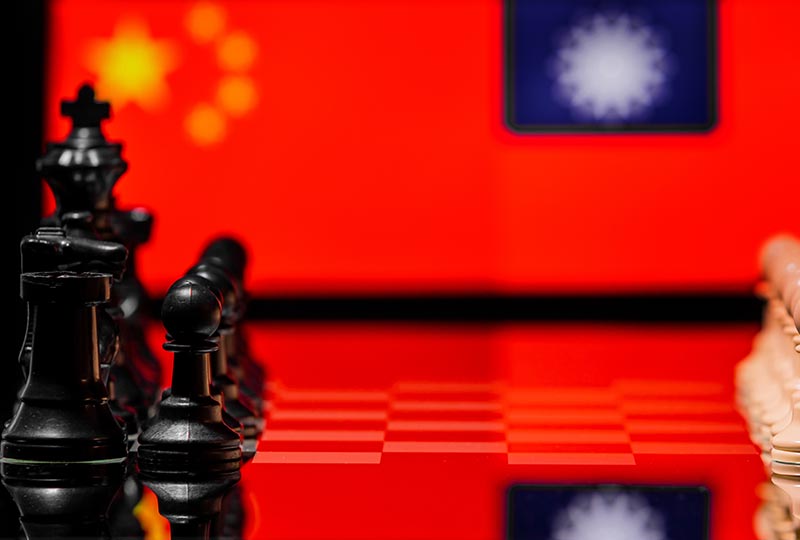
Much of the world’s attention is focused on events in Europe these days, specifically the war in Ukraine. But a potentially more far-reaching and disruptive conflict remains simmering in Asia—China’s bellicose moves in and around Taiwan.
So far, China has merely stirred the pot, without actually igniting a hot war. But it maybe be only a step or two away from a major escalation—and that could have serious ramifications not just for trade in the Far East, but possibly a world-wide economic dislocation.
Recently, Taiwan seized a Chinese-crewed cargo ship it claimed was interfering with an undersea telecom cable connecting Taiwan to its nearby islands. In response, China launched live-fire drills near Taiwan, which consisted of 32 military aircraft and warships. Incidents like this could easily touch off a major conflict. Taiwan’s defense ministry charged it was a “blatant provocation” and direct threat.
Many military exercises have led to direct conflicts, so Taiwan readied its armed forces appropriately. The incident also made Australia and New Zealand extremely nervous, though they maintained that the maneuvers all occurred in international waters.
The episode hardly even registered a blip on the U.S.’s proverbial radar screen as Trump focused on his trade wars and the Russia-Ukraine conflict. The official U.S. policy toward defense of Taiwan is “strategic ambiguity,” meaning no definite commitment of military intervention exists, though the U.S. is bound to provide Taiwan with military assistance. However, President Joe Biden was much more vocal in implying that the U.S. would intervene than President Trump has been, at least so far.
But the likely question, is what impact would a military conflict in Asia, whether direct invasion by Chinese forces or a blockade of Taiwan, have on the world economy?
The outlook for semiconductors
The most critical economic concern at the moment is, what happens to semiconductors? Taiwan Semiconductor Manufacturing Company produces 90% of the world’s computer chips. “Industries from autos to medical devices depend on these chips; if Taiwanese chip production is disabled, the global economy could be plunged into a deep slump,” noted Eyck Freymann, a Hoover Fellow at Stanford University and Hugo Bromley, a Research Fellow at the Center for Geopolitics at the University of Cambridge in The Wall Street Journal.
Because Taiwan is so critical to the global semiconductor industry, a Chinese attack on the island would result in trillions of dollars in costs on the global economy, added the Danish Institute of International Studies, “But a Taiwan crisis also threatens to disrupt China-centered production and supply chains for green technologies, such as electric vehicles, solar panels, and wind turbines.”
And what would happen if the U.S. and other nations imposed an embargo on China? It would certainly have a much more devastating impact than the embargo imposed on trade with Russia. That’s because thousands of companies in the U.S., Europe, Far East, and other regions rely on China as being central to their supply chains.
In addition, the world can expect that China would retaliate against nations that imposed sanctions—economic or political.
“Even conservative estimates, such as those from the Rhodium Group, place the immediate loss to the global economy from a Chinese military blockade of Taiwan at above $2 trillion,” commented the Danish think tank. “In contrast, Bloomberg economists see the costs of a blockade causing some $5 trillion in economic damage in the first year. This estimate amounts to a 5% drop in the global economy (the global financial crisis in 2009 saw a 5.9% fall).”
Many companies doing business in China argue that the Chinese are not likely to engage Taiwan in a conflict since the cost would be very high to its own economy, and could destabilize the population. But the Chinese have long sought unification, and may see now as the time to strike as the U.S. is distracted elsewhere and President Trump has made it a policy of nonintervention.
So, what could the U.S. do? Not intervene to save Taiwan, or get involved and risk a world war. However, there is third option, promoted in an article in Foreign Affairs, called “The Taiwan Fixation.”
“Washington must make a plan that enables Taiwan to mount a viable self-defense, allows the United States to assist from a distance, and keeps the U.S. position in Asia intact regardless of how a cross-strait conflict concludes. This way, the United States could abstain from sending its military forces to defend Taiwan if China invades the island and does not attack U.S. bases or warships.”
This might seem like a weak response in the eyes of our Eastern allies. But judging from the lack of more forceful warnings from the Trump Administration, it is probably the most likely choice at this time.