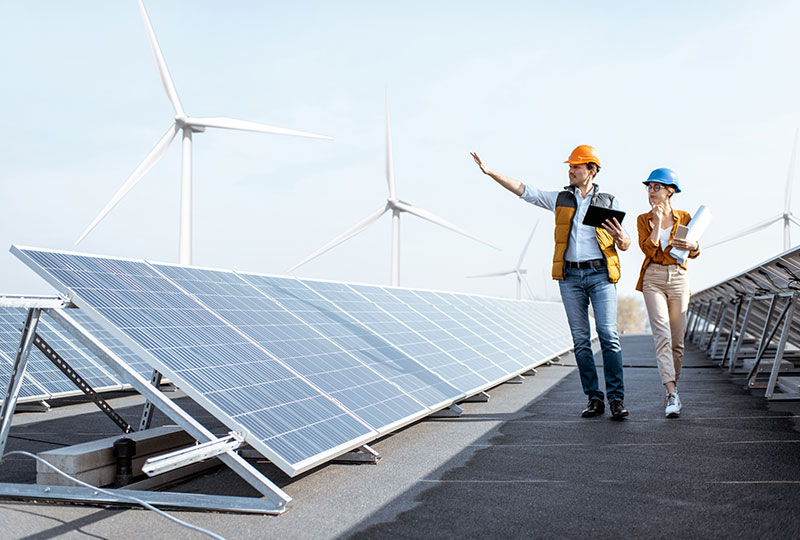
Business executives and investors around the world continue to pour funds into all kinds of technology designed to provide clean alternatives to fossil fuels.
Investment in energy on a global basis is increasing towards a record-breaking rate, according to the International Energy Agency. The worldwide glut in fossil fuels is not preventing clean energy initiatives to grow as a key segment.
“Investment in clean technologies—renewables, nuclear, grids, storage, low-emissions fuels, efficiency, and electrification—is on course to hit a record $2.2 trillion this year, reflecting not only efforts to reduce emissions but also the growing influence of industrial policy, energy security concerns, and the cost competitiveness of electricity-based solutions,” according to the 2025 edition of the IEA’s annual “World Energy Investment” report.
The Trump Administration, however, has pulled back from past private and public commitments to all forms of clean energy. The Securities & Exchange Commission is no longer pushing companies to implement carbon-reduction policies, for example.
The new Administration has brought about the “sudden reversal” of clean energy policies put in place by the prior Administration’s Inflation Reduction Act (IRA), note Oxford Economics.
“The IRA had incentivized unprecedented investment in U.S. clean technology manufacturing. In Q4 2024 alone, over $16 billion was invested in new manufacturing capacity. Now, that momentum is reversing. The first quarter of 2025 saw a drop in investment and $6.9 billion worth of clean tech manufacturing projects cancelled—the highest quarterly cancellation value on record.”
Prompted by the U.S. government, many private companies have diluted their commitment to clean energy. The Wall Street Journal reported that the number of firms using the term “net zero” in proxy statements has already dropped 32%, while mention of “carbon neutral” fell 30%.
U.S. retreat leaves China the major innovator
The U.S. retreat from clean energy tech innovation has only emboldened other countries to step up their clean tech investments. The U.S. risks being left behind.
“Today, China is by far the largest energy investor globally, spending twice as much on energy as the European Union—and almost as much as the EU and United States combined,” commented Fatih Birol, Executive Director of the International Energy Agency. Birol noted that over the past decade, China’s share of global clean energy spending has jumped from a quarter to almost a third. “China is becoming global leader in strategic investments in a wide range of technologies, including solar, wind, hydropower, nuclear, batteries, and EVs.”
While the U.S. government may be reluctant to push new clean energy investments, private markets still have lots of interest, according to a Bloomberg report, “Private Market Outperform for Clean Energy Investors.”
“There’s a lot of innovation happening and being financed to develop climate-mitigation solutions in private markets,” said Abdulla Zaid, Vice President at MSCI. “This area of the market has been known for its opacity, and investors may need to take a closer look at how their portfolio companies are positioned to capture value from the transition and how they may leverage climate-related technological innovation and shifting policy.”
What may yet fuel major investment in U.S. clean energy is the unsatiable demand for power brought about by the proliferation of Artificial Intelligence, which is all the rage across technology sectors. There is sure to be abundant need for transmission infrastructure and power generation as data centers spring up to support AI innovation.