It used to be only oil that was in short supply. Now, it’s rare earth minerals. The mineral supply crisis has been brewing for years. But suddenly, it has become a major domestic trade and national security issue.
The U.S has long been short on such minerals, known as rare earths. These are a group of 17 elements, including 15 silvery-white metals called lanthanides, or lanthanoids, plus scandium and yttrium. Among the products dependent on these minerals are consumer electronics, electric vehicles (EVs), aircraft engines, medical equipment, oil refining processes, computers, automobiles, and military applications such as missiles and radar systems.
In 2022, the U.S. designated 50 minerals it claimed were essential for domestic economy and security. The problem is that the U.S. has a very limited supply of these minerals, as revealed during the pandemic’s supply chain crisis. The U.S. also has very limited refinery capacity. Thus, the U.S. has become dependent on trading partners to fill its mineral needs.
By contrast, China has over 50% of the world’s rare earth minerals. And now those minerals have become the center of an intense trade war between the two nations. The U.S. has actually imposed tariffs on some of these minerals to try and diversify its sources. China has responded to American trade pressure by imposing export restrictions on rare earth and other minerals.
“Circumventing China’s dominant position in global critical mineral supply chains will be a considerable, but not necessarily insurmountable, challenge in the coming year,” noted a report by TD Economics, U.S. Trade Vulnerabilities in Critical Minerals: Pressure Points Amid Rising Tensions. “In many cases, the U.S. can find (and in several instances already has found) alternative sources for the raw critical minerals that it requires.”
The big stick approach to hitting China hard on minerals actually started during President Trump’s first term, continued under President Biden, and now has intensified in Trump’s second term. But the minerals situation is becoming more dire as Trump imposed new tariffs on Canada, a leading secondary source.
Canadian minerals impacted by tariffs
“As the United States races to reduce its reliance on China for minerals vital for national, economic, and energy security, tariffs with Canada may drastically undermine these efforts,” commented a report, Canadian Tariffs Will Undermine U.S. Minerals Security, by The Center for Strategic and International Studies.
It pointed out that Canada is the biggest source of the United States’ mineral imports, especially for uranium, aluminum, nickel, steel copper, and niobium. Consider these numbers: in 2023, Canada accounted for $47 billion of United States’ mineral imports. China followed with $28.3 billion.
“The consequences of tariffs would be particularly profound for the defense industry, nuclear energy, and heavy manufacturing. A 25% tariff on Canadian mineral imports could cost U.S. off-takers an additional $11.75 billion—a figure that would increase as base metal and uranium prices recover.”
To its credit, the U.S. is scouring the globe for new sources of these critical minerals. But instead of patient and diplomatic negotiations, it is using a heavy hand to try and develop the sources.
The United States found one such source in Ukraine. Ukraine possesses one Europe’s largest deposits of critical minerals, including lithium and titanium. The Institute of Geology noted that Ukraine also has rare earth elements such as lanthanum and cerium, used in TVs and lighting; neodymium, used in wind turbines and EV batteries; and erbium and yttrium utilized in nuclear power, lasers, and more.
The estimated value of these minerals is more than £12 trillion. But President Volodymyr Zelenskyy of Ukraine has been trying to get nations and firms to come in and extract the minerals, no small undertaking during active wartime. A deal between the U.S. and Ukraine is pending, but could fall apart because of a rift between Trump and Zelensky.
Then there is Greenland, which Trump has tried to pry away from Denmark without success. Greenland contains some of the largest deposits of rare earth elements on Earth, such as yttrium, scandium, neodymium, and dysprosium.
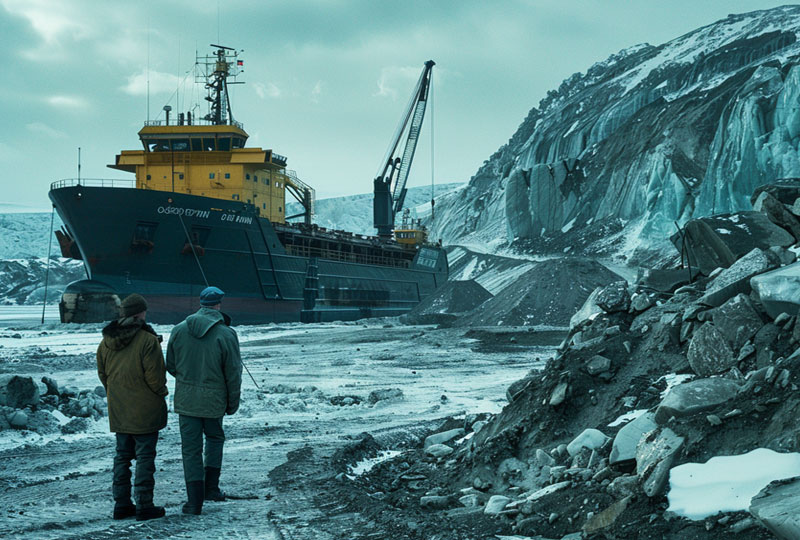
Lately there has been an upsurge in mining and extraction activity in Greenland, which has many barriers to development. They include a very hostile environment, cold temperatures, the lack of a strong labor force, and environmental regulations.
But the potential is enormous, and Trump is using his typical high pressure PR tactics to sway Greenland’s population in favor of extraction. So far, Denmark has resisted any attempts to sell Greenland’s resources to the U.S. But many Greenlanders are open to U.S. investment. Still, given the harsh terrain and climate, it could be years before the U.S. extracts significant minerals from the small nation. As one Greenlander noted to The New York Times, Greenland’s mineral wealth is very exciting, but, “there’s no quick buck.”